


No House. No Marriage. No Children.
For decades, Vietnamese society treated three milestones as the defining markers of adulthood: buying a home, getting married, and having children.
But for today’s younger generation particularly Gen Z and younger Millennials those once “expected” life goals are increasingly becoming financial and emotional burdens that feel out of reach.
As housing prices continue to rise faster than incomes, living costs climb, and economic uncertainty deepens, many young Vietnamese are beginning to ask a difficult question:
Is the traditional model of adulthood still realistic?
Rising Housing Prices Are Pushing the Dream of Homeownership Further Away
According to data from the Vietnam Association of Realtors (VARS), the market recorded nearly 40,000 new housing products in the third quarter of 2025, bringing total supply for the first nine months of the year to over 100,000 units – a 22% increase compared to 2024.
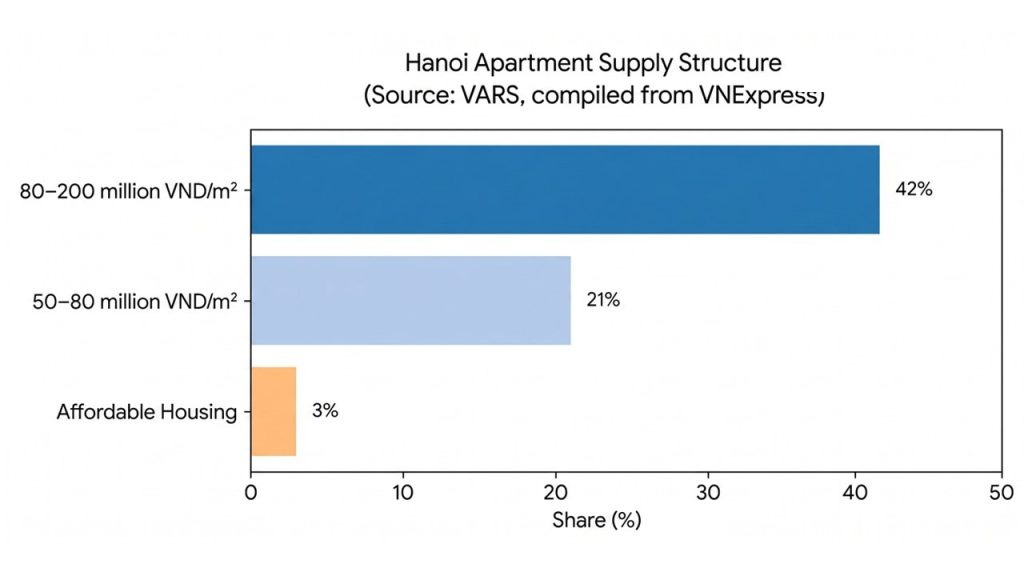
However, most of that supply remains concentrated in the high-end segment.
Meanwhile, apartment prices in Hanoi and Ho Chi Minh City now average around VND 90–95 million per square meter, with many projects surpassing VND 120 million per square meter.
The widening gap between income growth and property prices has made homeownership increasingly unattainable for many young workers.
A standard 70-square-meter apartment in Ho Chi Minh City can now cost between VND 6–7 billion. Even for a young couple earning a combined monthly income of VND 35 million and saving VND 15–20 million per month, purchasing a home without significant debt could take decades.
When Owning a Home Is No Longer a Life Goal
According to VNExpress, many real estate experts believe the market is increasingly driven by investors rather than genuine homebuyers.
Nguyễn Văn Đính, Chairman of VARS, noted that soaring housing prices are causing many young people to “lose motivation to own a home,” contributing to delayed marriage and declining birth rates.
Instead of pursuing homeownership, more young Vietnamese are:
choosing long-term renting,
living with parents for longer periods,
or moving away from major cities to reduce financial pressure.
Demand for rental housing in large urban areas has also risen significantly as property ownership moves beyond the financial reach of much of the younger workforce.
Young People Are Becoming Increasingly Reluctant to Marry
Housing is not the only issue reshaping the priorities of Vietnam’s younger generation.
Attitudes toward marriage and parenthood are also changing rapidly.
Many young Vietnamese are delaying or entirely reconsidering marriage due to:
financial pressure,
the rising cost of raising children,
concerns about losing personal freedom,
and a broader sense of instability about the future.
For many young adults today, marriage is no longer viewed as a mandatory milestone, but rather a personal decision that requires careful consideration of finances, emotional readiness, and quality of life.
A Generation Redefining Success
If previous generations viewed homeownership and starting a family as symbols of stability and success, many young people today prioritize something different:
personal experiences,
mental well-being,
flexible careers,
and short-term financial freedom.
This shift does not necessarily reflect a lack of ambition, as older stereotypes often suggest.
Instead, it reflects a generation trying to adapt to:
rapidly rising real estate prices,
increasing living costs,
a highly competitive job market,
and growing pressure to achieve financial success at a young age.
In this context, choosing not to buy a house, marry early, or have children is often less about rejecting traditional values and more about responding to increasingly difficult economic realities.
Conclusion
For years, young people in Vietnam were taught that hard work would eventually lead to a stable life: a home, a family, and long-term security.
But for many young Vietnamese today, that equation no longer feels straightforward.
As housing prices continue to outpace incomes, living expenses rise, and economic uncertainty persists, adulthood itself is becoming increasingly difficult to afford.
And perhaps the most significant shift is not that young people no longer want marriage or homeownership but that many are no longer certain they can realistically achieve them.
This article was originally published on Vietnam Operations: https://vietnam-operations.com/are-young-vietnamese-people-giving-up-on-the-traditional-dream/