


Vietnam’s Gen Z Workforce Is Changing the Management Equation
Discussions about Gen Z at work often focus on familiar stereotypes:
They want flexibility.
They change jobs quickly.
They dislike hierarchy.
They want constant feedback.
But the more important business question is:
What happens when a younger workforce enters organisations whose management systems were designed for a different generation?
That question is increasingly relevant in Vietnam.
TopCV previously estimated that Gen Z could account for around 25% of Vietnam’s workforce by 2025, reflecting its growing importance in recruitment and workforce planning.
More recent research shows that the management challenge is becoming more visible. A 2026 Robert Walters survey found that 91% of employers in Vietnam reported challenges managing Gen Z professionals. At the same time, 72% of organisations surveyed were open to hiring Gen Z, while 56% valued their digital and technology skills.
The contradiction is clear:
Companies increasingly want Gen Z talent, but many are still managing it with older systems.

The Problem Is Not Simply Gen Z
It is easy to say:
“They don’t stay long enough.”
Or:
“They don’t respect hierarchy.”
But these statements are not particularly useful management diagnoses.
A better question is:
What is the organisation doing when employees ask for these things?
If employees want feedback, does the company have a structured feedback process?
If they want career development, is there a clear career path?
If they expect flexibility, are performance outcomes clearly defined?
Vietnamese HR sources consistently identify career development, flexibility, communication, continuous learning and workplace relationships as important factors in managing Gen Z.
A University of Economics Ho Chi Minh City study involving 318 Gen Z employees aged 18–28 in Ho Chi Minh City examined salary and benefits, career development, organisational culture, workplace relationships and job satisfaction in relation to job-hopping. The study found workplace interpersonal relationships had the strongest direct relationship with job-hopping tendencies within its sample.
This suggests an important operational lesson:
Retention is not necessarily only a compensation problem. It can also be a management-system problem.
1. Gen Z Does Not Eliminate Hierarchy. It Changes How Hierarchy Works
The idea that Gen Z simply dislikes hierarchy is too simplistic.
Younger employees may still accept authority, but increasingly expect explanation, participation and feedback alongside authority.
TopCV highlights Gen Z’s tendency to express opinions and respond positively to constructive feedback.
For businesses, this does not mean removing hierarchy.
A manufacturing plant still needs production controls.
A finance team still needs approval procedures.
A multinational still needs compliance rules.
The change is in the management process:
Manager → instruction → employee → execution
becomes:
Manager → objective + boundaries → employee → execution → feedback → adjustment
Authority remains. The operating model becomes more transparent.
For foreign companies, this distinction is especially important. A Vietnamese employee questioning a process may not necessarily be challenging authority; they may be identifying an inefficient process.
The solution is to define clearly:
What is mandatory
What can be adapted locally
What requires approval
What employees can decide independently
How issues are escalated
2. From Micromanagement to Measurable Accountability
VMP Academy argues that rigid processes and micromanagement can reduce motivation among Gen Z, recommending more empowerment, outcome-based management and coaching.
This does not mean giving employees unlimited freedom.
It means managers need to define outcomes more clearly.
Instead of:
“Prepare this report using this format and these five sources.”
Managers can say:
“We need a market update for tomorrow’s meeting. Identify the three most important changes, provide supporting data and explain their business implications.”
The second approach creates more autonomy and clearer accountability.
For foreign companies, it is particularly useful when headquarters processes need to be adapted to Vietnam.
3. Feedback Cannot Be an Annual Event
Traditional organisations often concentrate performance discussions around annual reviews.
That can create a simple problem: employees discover too late that their manager has been dissatisfied with their performance for months.
VMP recommends more continuous feedback and guidance, while GEM Global also highlights communication and people-development skills as important for Gen Z management.
A simple management rhythm can help:
Weekly: progress and blockers
Monthly: achievements and improvement
Quarterly: goals and development
Annually: compensation, promotion and long-term planning
The annual review should summarise the management process, not replace it.

4. Career Development Is Becoming an Operating Requirement
Across the Vietnamese sources, career development appears repeatedly as an important Gen Z expectation.
The practical question for companies is:
Can you show an employee what the next three years could look like?
This does not mean promising promotion.
It means creating a visible pathway:
Junior Executive → Executive → Senior Executive → Manager
with clear expectations around:
Skills
Performance
Training
Responsibilities
Decision-making
For foreign companies establishing teams in Vietnam, this is particularly important. A strong international employer brand does not automatically create a clear career path for employees in a small local subsidiary.
[Link nội bộ: Vietnam HR & Employment Guide | Anchor text gợi ý: “understanding Vietnam’s employment and HR framework”]
5. Job-Hopping Should Be Analysed, Not Simply Blamed on Gen Z
Job-hopping is one of the most common concerns surrounding Gen Z.
A 2026 report citing TopCV’s employment data found that 36% of Gen Z respondents had changed jobs in 2025, making Gen Z the group most willing to change jobs in that survey.
RMIT University Vietnam has also reported that young professionals in Vietnam averaged around 2.2 years per job, compared with 3.2 years for Millennials and 4.3 years for Gen X.
These figures should not be interpreted as meaning every Gen Z employee will leave quickly.
They do suggest that companies should analyse turnover rather than blame it on age.
Management should ask:
Which teams have the highest turnover?
When do employees leave?
Are high performers leaving?
Are departures connected to managers, workload, compensation or career progression?
What does exit data actually show?
Employee tenure should be treated as a management metric, not a generational stereotype.
6. The Manager May Be More Important Than the HR Policy
A company can offer:
Competitive salaries
Flexible working
Training
Benefits
A modern office
and still lose employees.
The reason is simple: the line manager shapes the employee’s daily experience.
Managers determine how work is assigned, how mistakes are handled, how feedback is delivered and whether employees see a future in the company.
The UEH study’s finding on workplace relationships reinforces this point.
For this reason, improving Gen Z retention often starts with improving manager capability, not simply adding more HR benefits.
7. Technology Helps But Technology Is Not the Strategy
Gen Z’s digital fluency makes HR technology increasingly relevant.
MISA identifies technology applications as one element of modern Gen Z management, alongside recruitment, retention and intergenerational management.
Technology can support:
Recruitment
Employee records
Payroll
Performance tracking
Training
Feedback
Communication
But software cannot fix unclear KPIs, weak managers or poor career paths.
Technology should support the management system, not replace it.
What Foreign Companies in Vietnam Need to Change
For foreign investors, Gen Z is also a market-entry and operational issue.
A company entering Vietnam is not simply importing its existing management model. It is operating within a local labour market with its own expectations and workplace culture.
Companies should therefore review five areas:
Recruitment
Explain responsibilities, reporting lines, performance expectations and career opportunities.
Onboarding
Clearly define organisational structure, communication norms, decision rights and escalation procedures.
Performance Management
Use measurable KPIs linked to actual business outcomes.
Management
Train managers to coach, communicate and give regular feedback.
Retention
Use employee and exit data to identify why people actually leave.
[Link nội bộ: Vietnam Company Setup Guide | Anchor text gợi ý: “setting up a compliant company and operating structure in Vietnam”]
A Practical Gen Z Management Framework
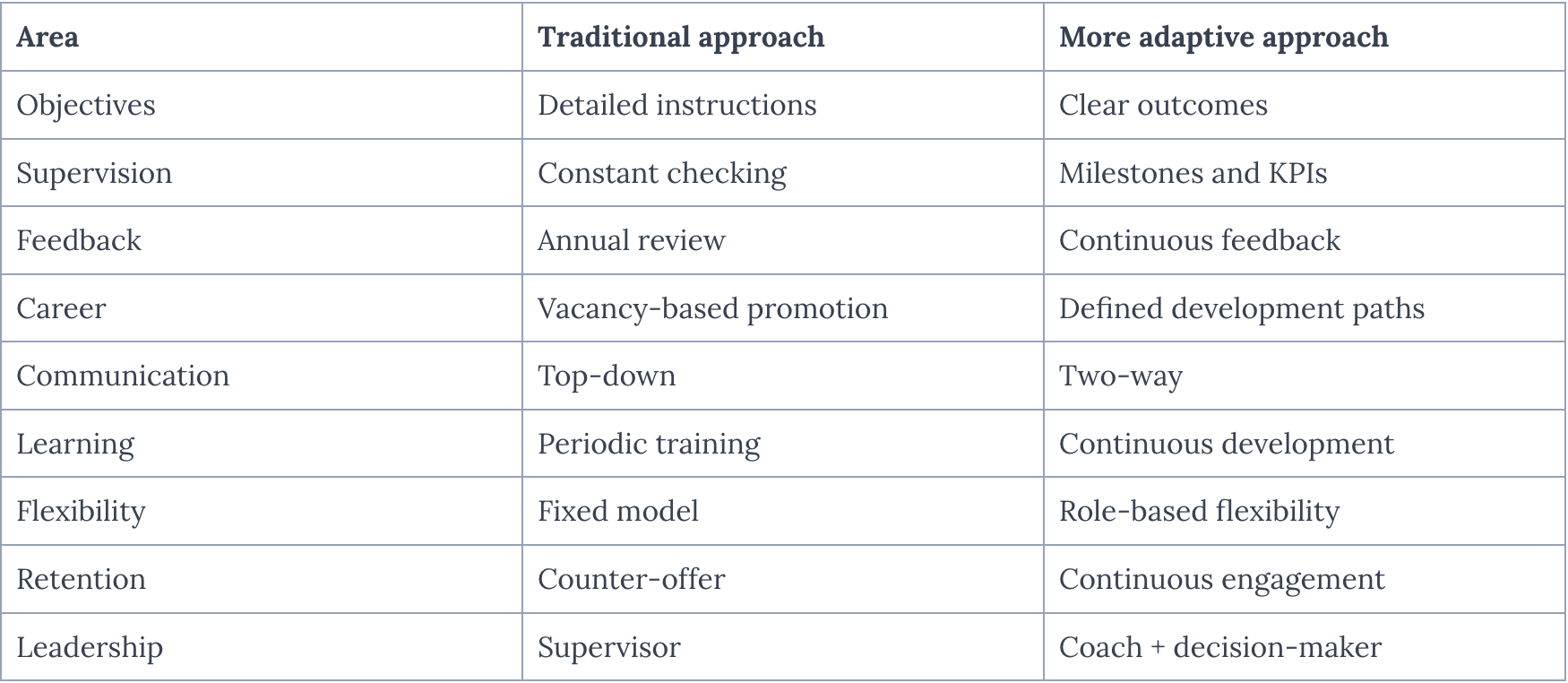
Importantly, this is not only a Gen Z management model.
Many of these practices improve management across generations.
Gen Z simply makes weaknesses in existing systems more visible.
The Bigger Lesson for Vietnam’s Foreign-Invested Businesses
Vietnam’s labour force reached approximately 53.5 million people in 2025, according to the General Statistics Office. Average monthly employee income reached approximately VND 8.4 million for the year.
As Vietnam continues to attract manufacturers, technology companies and service businesses, competition for capable employees remains an operational consideration.
For a foreign company, the question should therefore not be:
“How do we make Gen Z behave like our existing employees?”
It should be:
“How do we build a Vietnam operation where younger employees can perform, develop and remain accountable?”
That requires more than recruitment.
It requires operational design.
Conclusion: Gen Z Is Exposing the Management System
The most useful way to understand Gen Z in Vietnam is not as a difficult generation, but as a stress test for management systems.
If employees need constant clarification, objectives may be unclear.
If employees leave after one year, career progression may be unclear.
If managers complain about excessive feedback requirements, performance management may be too infrequent.
If employees demand flexibility, the company may be measuring presence rather than output.
The answer is not to remove discipline.
Businesses still need accountability, productivity, compliance and clear performance standards.
The opportunity is to build systems where flexibility and discipline can coexist.
For foreign companies entering or expanding in Vietnam, HR should therefore be considered part of the operating model from the beginning, not a problem to solve after recruitment starts.
[Link nội bộ: Vietnam Tax & Employment Compliance Guide | Anchor text gợi ý: “understanding the employment, payroll and tax obligations of operating in Vietnam”]
Talk to Vietnam Operations
If you are building or expanding a team in Vietnam and need to understand how local hiring, management structure, employment compliance and day-to-day operations fit together, Vietnam Operations can help you assess the operational setup before problems become expensive to fix.
Book a consultation with Vietnam Operations to discuss your Vietnam market-entry or operating plan.