


A New Type of Relationship Is Emerging Among Young People
Over the past few years, a new type of relationship has become increasingly common among young people in Vietnam: the “situationship.”
It is not quite a romantic relationship, but it is also more than friendship.
People in these relationships often text every day, spend time together, share emotions, care for one another, and even behave like couples. Yet when asked to define the relationship, the answer is often unclear.
For many young people, phrases like:
“Let’s just keep things this way”
have become more common than official labels or long-term commitments.
Situationships describe relationships without clear definitions, commitments, or expectations — yet they can still become emotionally significant and difficult to leave behind.
A Generation Becoming More Cautious About Commitment
In the past, romantic relationships often followed a relatively straightforward path: attraction, dating, commitment, and eventually either continuation or separation.
However, Gen Z appears to be approaching relationships differently.
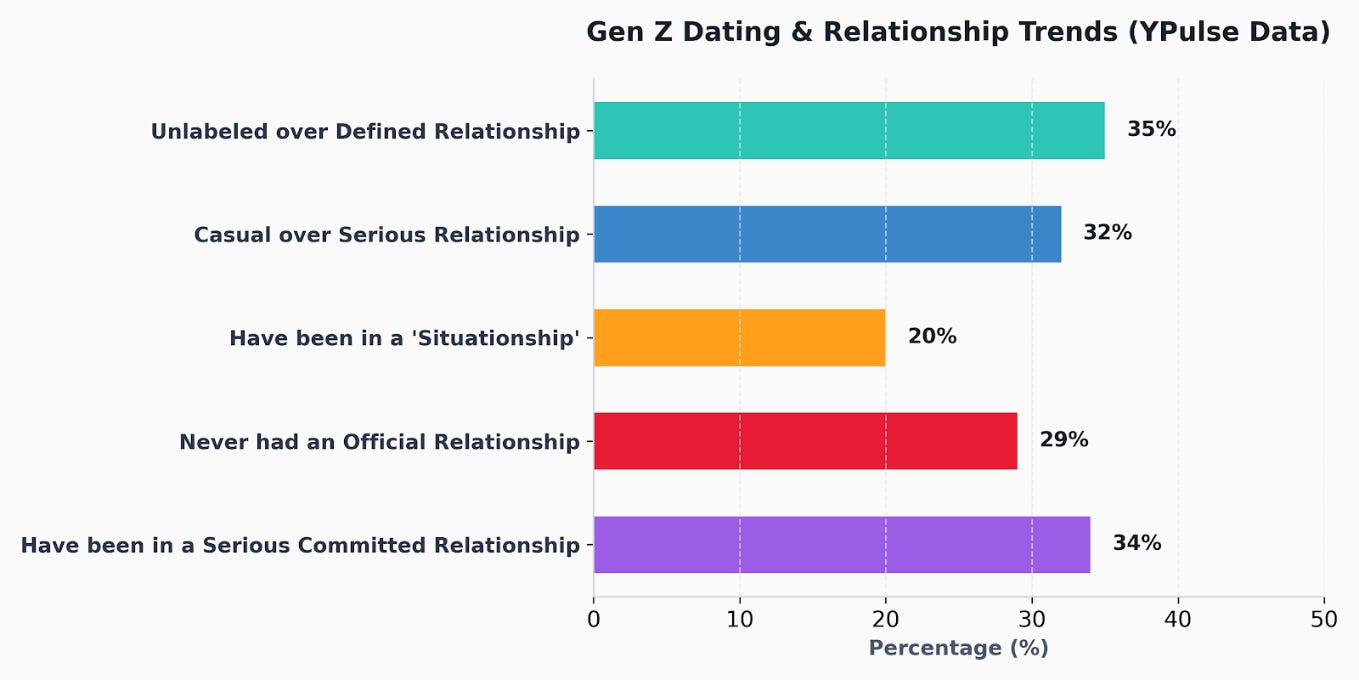
YPulse’s Dating & Relationships Report
Many young people today still seek emotional connection and companionship, but they are increasingly hesitant about the responsibilities and expectations traditionally associated with official relationships.
For some, ambiguity has become a form of emotional safety.
Situationships allow individuals to experience affection, intimacy, and companionship without fully stepping into long-term commitment. This creates a middle ground between emotional closeness and personal independence.
The shift also reflects broader changes in how younger generations view identity, freedom, and emotional well-being.
Dating Apps Have Changed the Nature of Modern Relationships
The rise of dating apps has further reshaped how relationships are formed and maintained.
Meeting new people is now faster and more accessible than ever before. With only a few swipes, users can instantly connect with countless potential partners.
However, this abundance of choice has also made relationships feel more replaceable.
Many young people now experience a constant feeling that:
“Someone more compatible might still be out there.”
As a result, some individuals become reluctant to fully invest in a single relationship. Rather than building stable long-term commitment, they keep relationships undefined in order to maintain flexibility and avoid emotional risk.
Ironically, having more options often makes emotional certainty more difficult to achieve.
Situationships Are Not Entirely Negative
Despite criticism surrounding “undefined relationships,” situationships are not always viewed negatively by young people themselves.
For many individuals, these relationships serve as opportunities to better understand themselves, learn about emotional connection, and recover from previous relationship experiences.
Some are simply not prepared for serious commitment because of:
work-related pressure,
financial instability,
personal growth priorities,
or emotional wounds from the past.
In this context, situationships function as a compromise:
maintaining emotional companionship without the pressure of a formal commitment.
However, problems often emerge when expectations are not communicated clearly.
One person may view the relationship as temporary companionship, while the other may interpret it as the beginning of a serious romantic relationship.
In many cases, it is this uncertainty and lack of clarity that becomes emotionally exhausting.
Gen Z Does Not Hate Love - They Are Redefining It
The growing popularity of situationships does not necessarily mean that young people are rejecting love altogether.
Gen Z still seeks emotional intimacy, companionship, and meaningful human connection.
What is changing is the way relationships are approached.
A generation raised alongside social media, dating apps, and constant digital interaction is becoming:
more cautious about commitment,
more focused on emotional independence,
and more concerned about losing individuality within relationships.
At the same time, many young people are also beginning to feel emotionally drained by prolonged ambiguity. After years of experiencing undefined relationships, some are gradually moving back toward clearer and more intentional forms of commitment.
Situationships are therefore no longer simply a temporary dating trend.
They increasingly reflect how Gen Z is redefining love, attachment, and commitment in a rapidly changing social environment where relationships often feel more fluid, uncertain, and temporary than before.
This article was originally published on Vietnam Operations: https://vietnam-operations.com/gen-z-no-longer-wants-official-relationships-theyre-just-in-situationships/