

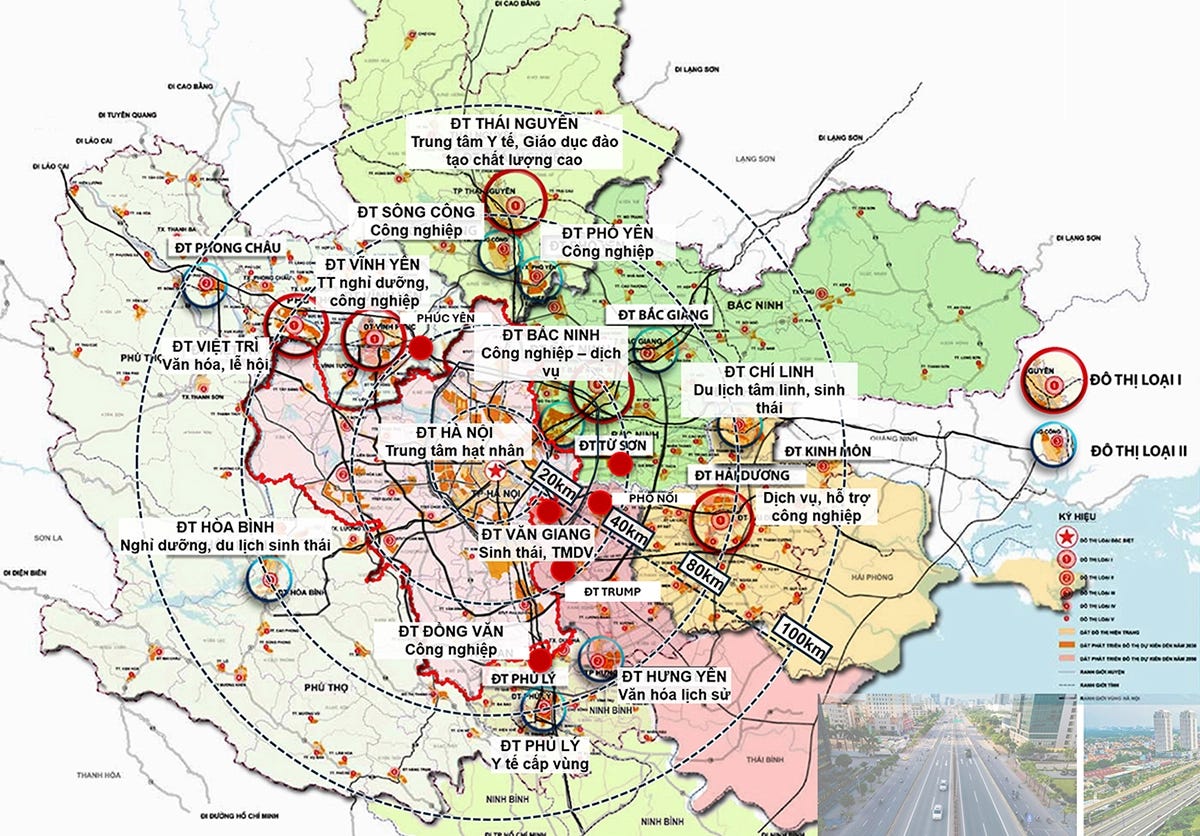
Most cities plan for the next decade.
Hanoi is planning for the next century.
The Vietnamese capital has unveiled a comprehensive master plan with a 100-year vision, outlining how the city intends to reshape its economy, infrastructure, and urban landscape far beyond the usual political or investment cycle. Rather than simply expanding roads or building more housing, the plan proposes a fundamental redesign of how Hanoi grows and where future economic activity will happen.
For businesses, investors, and anyone watching Vietnam’s long-term development, this is more than an urban planning exercise.
It’s a roadmap for where public investment, talent, and economic opportunities could gradually shift over the coming decades.
Moving Beyond a Single-Center City
For decades, Hanoi’s economic and administrative activities have largely concentrated within its historic urban core.
While this concentration helped fuel growth, it has also created familiar challenges:
Traffic congestion
Rising property prices
Pressure on infrastructure
Uneven development between central and suburban districts
The new master plan aims to change that by transforming Hanoi into a polycentric city one with multiple growth centers instead of a single dominant downtown.
Instead of expecting every major business, institution, or investment project to cluster around Hoan Kiem, Ba Dinh, or Cau Giay, the city wants different districts to specialize in different economic functions.
This approach has become increasingly common among global metropolitan areas seeking more balanced and sustainable growth.
Nine Growth Poles, Each with a Different Role
One of the plan’s defining features is the creation of nine strategic development poles.
Rather than allowing every district to compete for the same industries, each area is assigned a distinct economic identity.
Some notable examples include:
Hoa Lac as Vietnam’s leading science, technology, innovation, and higher education hub, anchored by Hoa Lac Hi-Tech Park and Vietnam National University.
Son Tay – Ba Vi focusing on eco-tourism, cultural heritage, and recreation.
Xuan Mai developing around education, healthcare, and green urban living.
Northern Hanoi (Dong Anh – Me Linh – Soc Son) becoming an airport-oriented economic zone supported by logistics and aviation-related industries.
The Red River corridor evolving into a new space for finance, commerce, tourism, and cultural activities.
Instead of creating identical satellite cities, Hanoi is attempting to build complementary economic clusters that reinforce one another.
Nine Major Urban Centers
Alongside the development poles, the city also identifies nine major urban centers, each responsible for key economic or administrative functions.
These include:
Finance
International business
Logistics
Healthcare
Education
Innovation
Government administration
For example:
The South Red River area is expected to become a new administrative, financial, and international integration center.
Phu Xuyen is positioned as a logistics and high-tech manufacturing hub.
Hoa Lac strengthens its role as Hanoi’s innovation ecosystem.
Son Tay continues to develop around tourism and cultural industries.
Rather than concentrating every strategic function in one location, Hanoi is distributing economic activities across the metropolitan region.
Infrastructure Becomes the Growth Strategy
Cities rarely grow by accident.
They grow where infrastructure allows them to.
That’s why another major component of the plan is the creation of nine strategic development corridors connecting the city’s future growth poles.
Among them are:
Nhat Tan – Noi Bai
West Lake – Co Loa – Gia Binh
Hanoi – Hai Phong Expressway corridor
Thang Long Boulevard
Ring Road 4
National Highways 1, 6 and 32
The Red River development corridor
Rather than treating roads as isolated transportation projects, Hanoi is using infrastructure to guide where businesses, industries, and new urban districts are likely to emerge over time.
This reflects a broader planning philosophy seen in many successful global cities: transport networks don’t simply connect economic activity they create it.
Planning for a Three-Dimensional City
Perhaps one of the less discussed but more ambitious aspects of the master plan is its emphasis on multi-layer urban development.
Instead of expanding only outward, Hanoi intends to develop simultaneously:
Underground spaces
Surface-level urban areas
Elevated infrastructure
The plan also integrates multiple layers of urban value, including:
Heritage preservation
Ecological systems
Digital infrastructure
Transportation
Public services
As land becomes increasingly scarce while the population continues to grow, maximizing vertical and underground space could become an important part of Hanoi’s long-term urban strategy.
What Does This Mean for Businesses?
From a Vietnam Operations perspective, the master plan is less about where buildings will be constructed.
It’s about where future economic momentum may gradually shift.
In many countries, once governments designate strategic growth zones, public investment typically arrives first:
Transport infrastructure
Utilities
Universities
Hospitals
Industrial parks
Innovation districts
Private investment often follows.
That doesn’t mean every location identified in the master plan will immediately become a growth hotspot.
Implementation will take years if not decades and priorities may evolve over time.
However, the document provides valuable signals about where Hanoi intends to allocate resources over the long run.
For companies considering manufacturing facilities, logistics operations, technology campuses, or regional headquarters, understanding these long-term directions can become an important part of location strategy.
A Master Plan Is Only the Beginning
A master plan doesn’t build a city execution does.
Hanoi’s 100-year vision will ultimately depend on infrastructure delivery, investment, administrative reforms, and consistent implementation over time.
But one thing is already clear: the city is planning far beyond the next five-year cycle. It is laying the foundation for the next century.
For businesses and investors, this isn’t a prediction of what will happen. It’s a strong signal of where Hanoi intends to direct its future growth.