

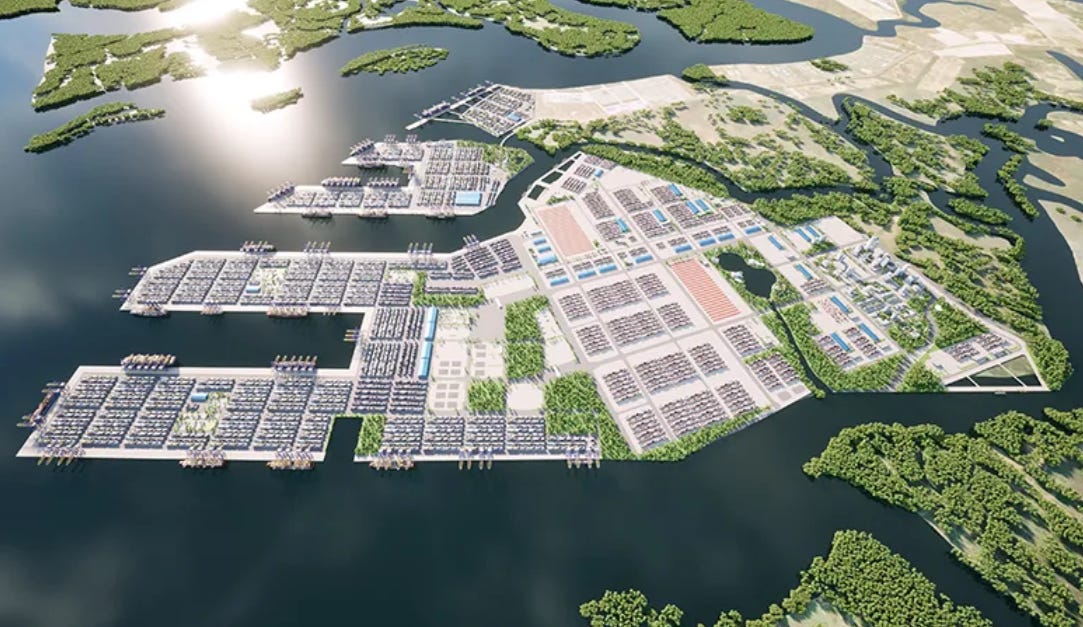
For years, Vietnam has talked about becoming Southeast Asia’s next logistics powerhouse.
Now, Ho Chi Minh City has taken one of its biggest steps toward that goal.
On 23 July 2026, the Ho Chi Minh City People’s Committee officially approved the establishment of a 4,174-hectare Free Trade Zone (FTZ) under Decision No. 4560/QĐ-UBND, located in Tân Phước and Tân Hải wards and closely connected to the Cái Mép Hạ port area. Unlike a conventional industrial park, this project combines ports, logistics, manufacturing, trade and urban services into one integrated economic ecosystem.
This announcement may not immediately change how companies operate in Vietnam today.
But it sends a clear signal about where the country’s long-term economic strategy is heading.
More Than Another Industrial Park
Vietnam already has hundreds of industrial parks.
A free trade zone serves a different purpose.
According to Decision 4560/QĐ-UBND, the FTZ will span 4,174.35 hectares, divided into three functional zones and eight sub-zones. The development integrates container ports, logistics centers, industrial production, commercial areas, research facilities and urban services into a single ecosystem designed to facilitate international trade.
Rather than simply offering land for factories, the city aims to create a place where goods can be imported, processed, stored, distributed and exported with fewer logistical barriers.
That distinction matters.
As global supply chains become more complex, companies increasingly value speed, customs efficiency and integrated logistics just as much as manufacturing costs.
Why Cái Mép Is the Centerpiece
The location is no accident.
The FTZ sits adjacent to the Cái Mép Thị Vải deep-water port system, approximately 25 km from Long Thành International Airport and around 50 km from downtown Ho Chi Minh City.
This strategic position allows manufacturers and logistics providers to connect ocean shipping, future air cargo and inland transportation within a single regional hub.
Cái Mép is already one of Vietnam’s most internationally connected ports, capable of receiving some of the world’s largest container vessels on direct routes to Europe and North America.
Instead of building an entirely new logistics center elsewhere, the government is expanding around an infrastructure asset that already exists.
Vietnam Is Competing on Logistics, Not Just Labor
For much of the past two decades, Vietnam’s appeal to foreign investors centered on competitive labor costs.
That equation is gradually changing.
As wages increase and global manufacturers diversify their supply chains, factors such as customs procedures, transportation infrastructure, warehouse capacity and delivery times become increasingly important.
The newly established FTZ reflects this broader shift.
According to VnEconomy, the project is intended to become a new growth pole that links the Cái Mép Thị Vải port cluster, the planned Cần Giờ International Transshipment Port, and Long Thành International Airport, creating a regional logistics network supporting manufacturing, trade and international distribution.
This suggests Vietnam is no longer competing solely on production costs.
It is increasingly investing in reducing friction throughout the supply chain.
What Businesses Should Watch
The FTZ remains in its early stages.
Infrastructure still needs to be developed.
Investment incentives, customs procedures and operating regulations will continue to evolve over the coming years.
However, companies operating in several sectors should pay close attention:
International logistics
Port operations
Third-party logistics (3PL)
Export-oriented manufacturing
Regional distribution centers
Cold chain logistics
Cross-border e-commerce
Supply chain technology
According to reporting by Thị trường Tài chính Tiền tệ, the city expects the FTZ to become a strategic platform for attracting high-value investment while strengthening Vietnam’s position in regional trade and logistics.
Meanwhile, Đầu tư Tài chính (SGGP) notes that the project is expected to support innovation, green logistics and advanced manufacturing rather than simply expanding industrial land.
The Bigger Picture
The establishment of the Ho Chi Minh City Free Trade Zone is about more than one development project.
It fits into a broader national strategy.
Over the past several years, Vietnam has accelerated investment in expressways, deep-water ports, airports and industrial infrastructure.
The objective is not simply to attract more factories.
It is to become a regional platform where goods are manufactured, consolidated, distributed and exported more efficiently.
Whether the new FTZ ultimately rivals established logistics hubs such as Singapore or Shenzhen remains to be seen.
But one thing is already becoming clear.
Vietnam is no longer trying to compete only as a low-cost manufacturing destination.
It is increasingly positioning itself as a country where global supply chains can operate faster, smarter and at greater scale.