

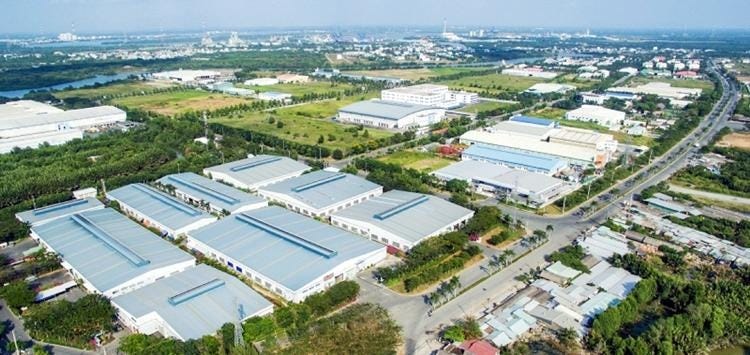
Over the past 30 years, industrial parks (IPs) and industrial clusters (ICs) have become one of the most important foundations of Vietnam’s industrialization. From an economy once heavily dependent on agriculture, Vietnam is gradually transforming into a major manufacturing hub in Asia, driven by the rapid expansion of its industrial zones.
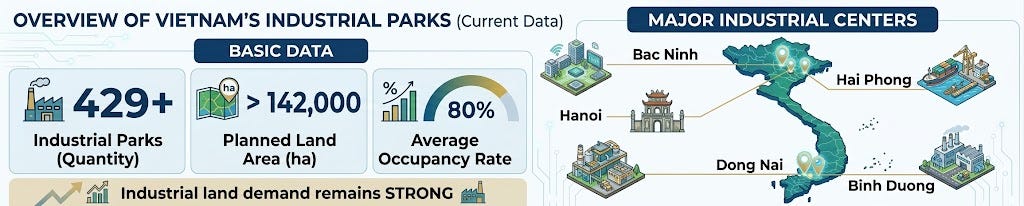
In particular, the Red River Delta region is emerging as the new industrial powerhouse of northern Vietnam thanks to its strong infrastructure network and strategic location near China. The region has also become the country’s largest destination for foreign direct investment (FDI) in recent years.
Industrial parks play a central role in attracting foreign investment. In 2025, Vietnam’s manufacturing and processing sector attracted approximately USD 21 billion in FDI, accounting for nearly 55% of the country’s total foreign investment inflows. At the same time, global supply chain shifts under the “China +1” strategy are helping Vietnam strengthen its position as one of Southeast Asia’s most attractive manufacturing destinations.
Many international companies choose Vietnam because of:
Competitive labor costs
Strategic proximity to China
A wide network of free trade agreements (FTAs)
A stable political environment
In Hanoi alone, 10 major industrial parks have attracted around USD 6.7 billion in FDI, mainly in electronics, precision engineering, and high-tech manufacturing.
Meanwhile, industrial clusters mainly support small and medium-sized enterprises (SMEs), local manufacturers, and supporting industries. These clusters help reduce scattered production in residential areas while creating more jobs for local workers. However, many industrial clusters still face challenges related to infrastructure quality, environmental treatment systems, and the ability to attract high-value businesses.
Despite strong growth, Vietnam’s industrial park system also faces several challenges, including:
Environmental pressure
Limited availability of clean industrial land
Underdeveloped logistics infrastructure
Shortages of skilled labor
Low value-added manufacturing
As a result, many local governments are shifting away from the “growth at all costs” approach and prioritizing high-tech, green, and renewable energy projects instead. This transition is considered an important step in helping Vietnam move higher up the global supply chain.
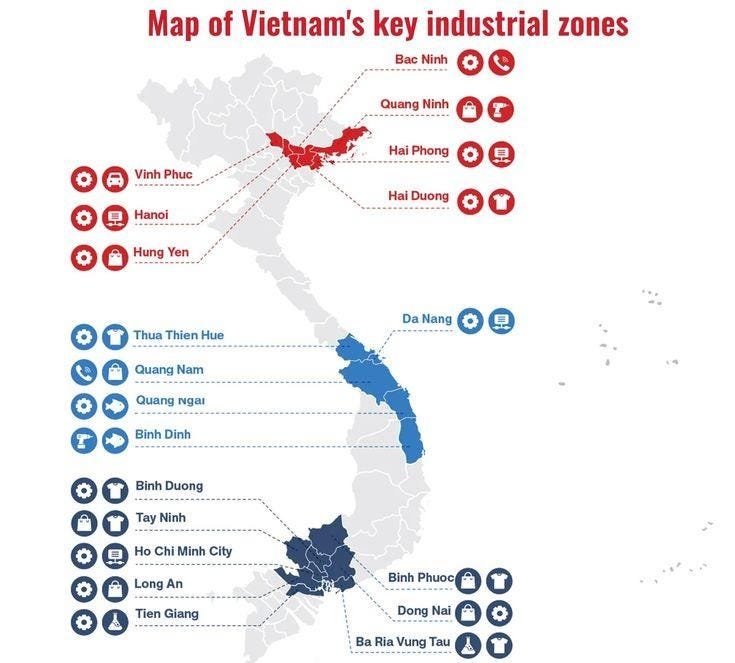
In the future, the key question for Vietnam will not simply be how many industrial parks it can build, but how it can develop industrial zones that are more sustainable, higher in value, and better connected to domestic businesses. The answer to that question may determine whether Vietnam can move beyond being a low-cost manufacturing base and become a leading high-tech production center in the region.