

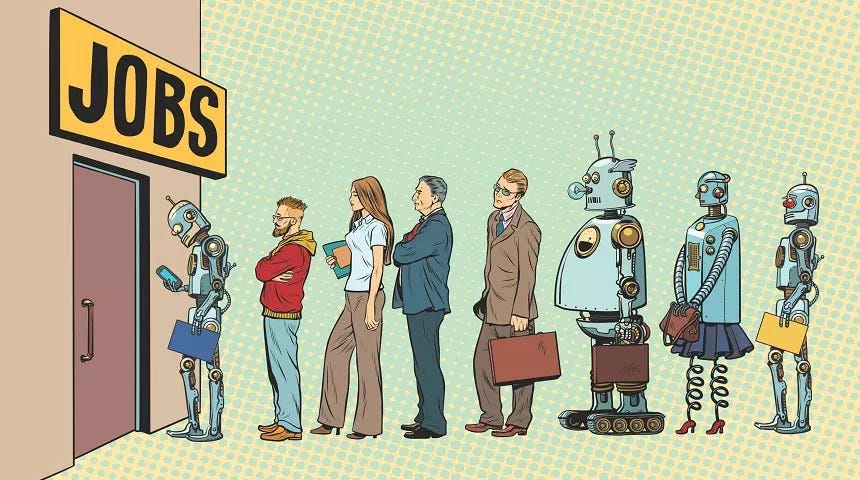
For years, when people talked about automation, they imagined robots replacing workers on factory floors.
But this AI revolution is different.
It is not starting in factories.
It is happening at desks.
A marketing employee can now create a first draft in minutes. A customer service team can use AI chatbots to handle thousands of conversations. A programmer can use AI tools to write and review code faster.
This raises a new question:
If AI can do many tasks that humans used to do every day, what will happen to Vietnam’s job market?
11.5 Million Vietnamese Workers Could Be Affected by AI
According to a report from the International Labour Organization (ILO), around 11.5 million Vietnamese workers or 1 in 5 workers are in jobs where some tasks could be affected by Generative AI.
However, the biggest change may not be job replacement.
It is a job transformation.
ILO suggests that Generative AI is more likely to change the way people work rather than completely remove millions of jobs overnight.
For example:
A financial employee may not lose their job because of AI.
But tasks like:
entering data
checking documents
creating basic reports
can increasingly be automated.
The value of human workers will move toward skills AI cannot easily replace:
problem-solving
communication
decision-making
strategic thinking
Which Jobs Are Under the Most Pressure?
Not every industry will be affected equally.
Jobs with three characteristics are more exposed to AI:
Repetitive tasks + clear processes + information processing.
According to ILO, administrative and office support workers are among the groups with the highest exposure to Generative AI.
Other sectors facing significant changes include:
finance and insurance
wholesale and retail
information and communication industries
The pressure is especially strong for entry-level jobs.
In the past, many fresh graduates started their careers by doing basic tasks:
writing reports, organizing information, processing documents, answering simple customer requests.
But if AI can handle much of this work, companies may expect new employees to bring more value from day one.
Are Young Workers the Most Vulnerable?
Maybe.
But not exactly in the way many people think.
AI is not only changing jobs.
It is changing the rules of entering the job market.
A candidate who only knows how to complete simple tasks may struggle.
Meanwhile, someone who combines professional knowledge with AI skills may have a stronger advantage.
For example:
A content writer may spend hours researching and drafting an article.
A writer using AI effectively can:
research faster
test more ideas
analyze audiences better
improve content quality
AI does not replace human ability.
But it can replace workers who only follow fixed processes.
AI Will Remove Jobs But It Will Also Create New Ones
The future of work is not only about job losses.
According to global employment forecasts cited by VnEconomy, AI and technological changes could contribute to the creation of around 170 million new jobs, while around 92 million existing jobs may be displaced or transformed.
New roles may grow around:
AI development
data management
AI quality control
AI safety
technology-related positions across different industries
History shows that every major technology wave changes the labor market.
The internet removed some traditional jobs.
But it also created new industries:
e-commerce, digital marketing, online services, and many technology careers.
Vietnam Is Entering a New Skills Competition
The biggest question is not:
“Will AI take our jobs?”
The bigger question is:
Who can adapt faster?
According to ILO, AI exposure is not evenly distributed across Vietnam. Major economic centers such as Hanoi, Ho Chi Minh City, and Da Nang account for more than one-third of jobs that could be affected by AI.
This means AI is not only a technology story.
It is also a story about:
education
reskilling
business adaptation
workforce competitiveness
The New Competition Is Not Humans vs AI
It is:
Humans who use AI vs humans who do not.
In the future, AI may become as common as Excel or the internet.
Employees who know how to use AI may complete tasks faster and create more value.
Companies that adopt AI effectively may become more competitive.
AI may not “eat” Vietnamese jobs.
But it is definitely changing the rules of the game.
And in this new game, the biggest advantage may belong to those who learn the fastest.