

For years, Vietnam has been known as one of Asia’s most attractive low-cost manufacturing destinations.
That description is no longer technically correct.
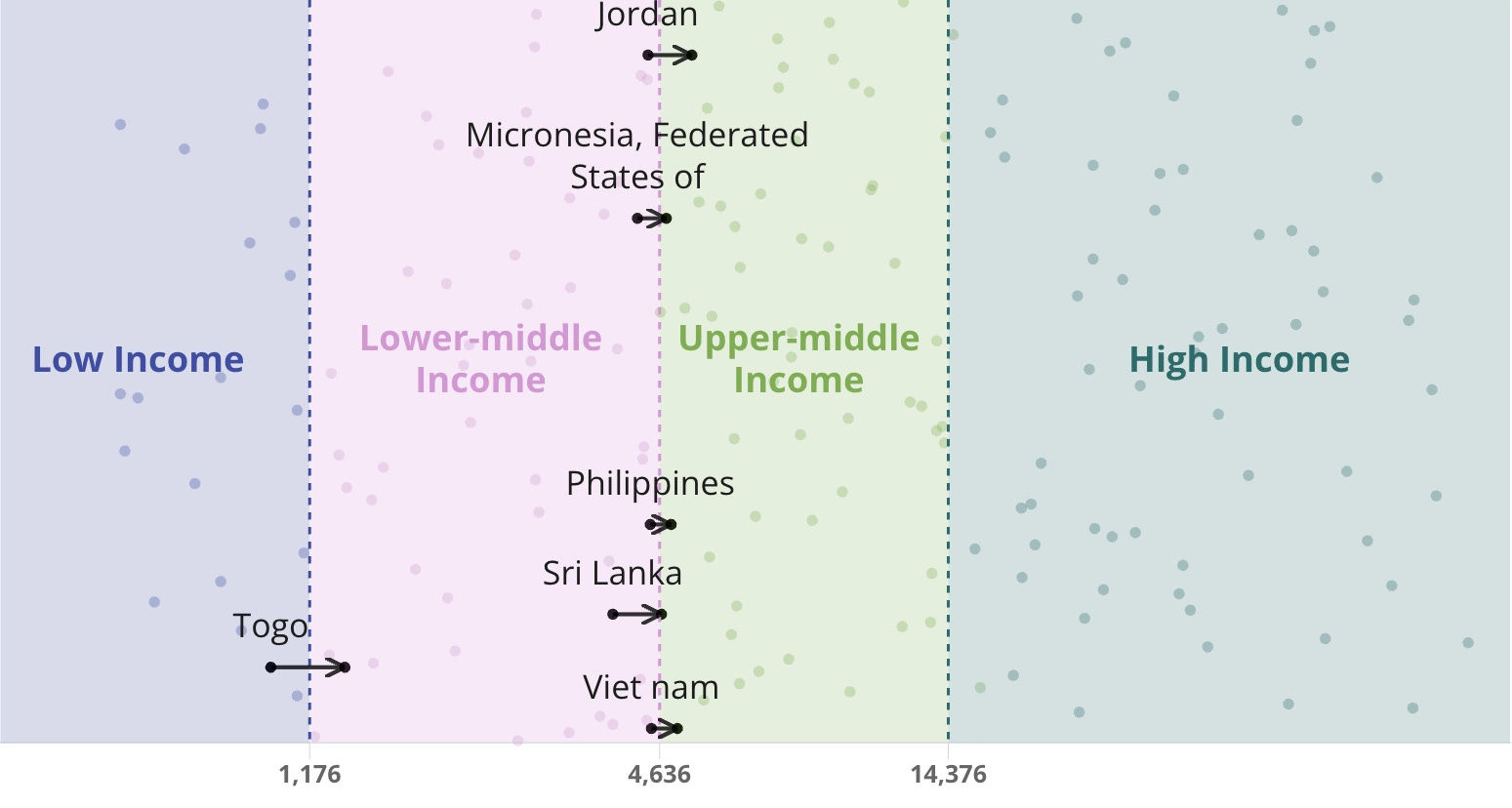
On July 1, 2026, the World Bank officially reclassified Vietnam from a Lower-Middle-Income Economy to an Upper-Middle-Income Economy, after the country’s Gross National Income (GNI) per capita reached US$4,970 in 2025 above the World Bank’s threshold of US$4,636. This annual classification, based on the Atlas Method, is used globally to compare countries’ income levels and development progress.
For many people, this sounds like a symbolic milestone.
For businesses, however, it signals something much bigger.
Vietnam Has Crossed an Important Economic Threshold
The World Bank updates its income classifications every July based on the previous year’s GNI per capita.
Vietnam has remained a lower-middle-income economy since 2009. Reaching the upper-middle-income group means the country’s income level has consistently risen over the past decade despite COVID-19, global inflation, and supply chain disruptions.
According to the World Bank, the upgrade was driven primarily by:
strong export growth exceeding 15% in both 2024 and 2025;
GDP growth of approximately 7% in 2024 and 8% in 2025;
sustained increases in national income per capita.
Does This Mean Vietnam Is Becoming Expensive?
Not necessarily.
One common misconception is that higher income automatically means Vietnam is losing its competitiveness.
That’s only partially true.
Yes, labor costs have increased significantly over the past decade.
But investors rarely choose Vietnam today solely because wages are cheap.
Instead, Vietnam increasingly competes on:
manufacturing capability
supply chain resilience
political stability
extensive free trade agreements
improving infrastructure
availability of skilled labor
This is consistent with what many multinational manufacturers have been doing over recent years expanding operations despite rising labor costs.
The investment story has gradually shifted from “cheap labor” to “efficient production.”
The Upgrade Could Improve Vietnam’s Global Image
Income classification is more than an economic statistic.
It affects how governments, international organizations, banks and multinational corporations perceive a country.
Although the World Bank has clarified that this year’s reclassification does not automatically change its lending policies, moving into the upper-middle-income group generally strengthens a country’s international credibility and may improve investor confidence.
For foreign investors evaluating multiple manufacturing destinations, perception matters.
Being classified alongside countries such as Thailand and Malaysia makes Vietnam appear increasingly mature as an investment destination.
But New Challenges Also Come With Higher Income
Higher income status also raises expectations.
Vietnam now faces increasing pressure to move beyond labor-intensive manufacturing.
Future growth will depend more on:
productivity improvements
automation
digital transformation
innovation
higher value-added industries
stronger domestic enterprises
As incomes rise, competing solely on low wages becomes increasingly difficult.
The next stage of Vietnam’s development will likely depend on whether it can generate greater value not simply produce more goods.
Vietnam’s Long-Term Goal Hasn’t Changed
The World Bank’s upgrade represents an important milestone, but it is not the final destination.
Vietnam’s national development strategy remains ambitious:
become an upper-middle-income country with a modern industrial base by 2030;
become a high-income developed economy by 2045.
Achieving those goals will require continued economic reforms, infrastructure investment, productivity gains, and deeper integration into global supply chains.
Final Thoughts
For international businesses, the World Bank’s announcement doesn’t mean Vietnam has become a high-cost country.
Instead, it confirms something many investors have already recognized:
Vietnam is evolving from being one of the world’s cheapest manufacturing locations into one of Asia’s most competitive production economies.
The country’s appeal is becoming less about low wages and more about long-term capability.