

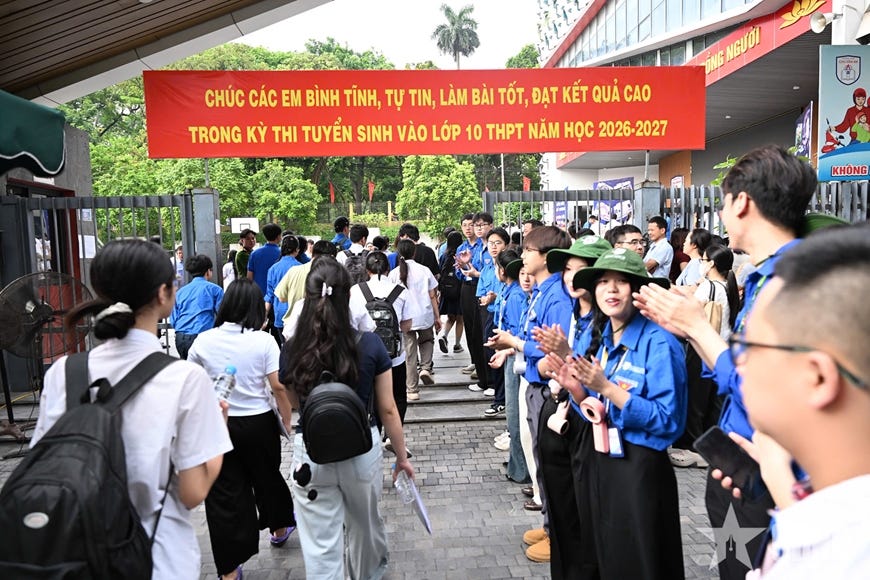
For years, university admission was considered one of the most stressful milestones for Vietnamese students.
But today, another competition is happening much earlier:
The Grade 10 public high school entrance exam.
In major cities, this exam is no longer simply about academic performance.
It has become a competition for access to a limited resource:
a seat in a public high school.
A Competition at Age 15
For the 2026–2027 school year, Hanoi recorded around 124,915 students registering for public Grade 10 entrance exams, while approximately 147,000 students completed lower secondary education. The number of candidates was among the highest in recent years.
At the same time, around 22,000 students did not participate in the public school entrance exam, choosing alternatives such as private schools, vocational education, continuing education, or other pathways.
On paper, this represents educational diversification.
But it also highlights a deeper reality:
Demand for public schools remains higher than available capacity in many areas.
When a Public School Seat Becomes a Competition
The 2026 admission data shows how intense the competition has become.
Some Hanoi public high schools recorded extremely high competition rates:
Yen Hoa High School: 1 seat against 3.35 applicants
Le Quy Don – Ha Dong High School: 1 against 3
Nguyen Thi Minh Khai High School: around 1 against 2.68
Yen Hoa High School received 2,566 applications for only 765 places.
For a 15-year-old student, these numbers are not just statistics.
They represent months of preparation, family expectations, and personal pressure.
Why Has Grade 10 Become So Stressful?
Part of the answer lies in the role public schools play in Vietnamese society.
For many families, public education is not only an academic choice.
It represents:
affordability,
stability,
perceived quality,
and a safer future pathway.
Therefore, failing to enter a preferred public school can feel like more than an exam result.
It can become a psychological burden.
The Paradox of Universal Education
The debate over reducing or removing Grade 10 entrance exams has continued for years.
Supporters argue that if education access is the goal, students should not face such intense competition just to continue high school.
Others raise a practical question:
If demand exceeds capacity, how should limited places be allocated fairly?
Because removing an exam does not necessarily remove competition.
It may simply move competition into another system:
academic records,
school zoning,
or alternative selection methods.
What Could Happen Next?
The pressure around Grade 10 admission is unlikely to disappear soon.
As cities expand, student populations grow, and families continue to invest heavily in education, demand for highly regarded schools will remain strong.
Future trends may include:
1. More competition around top public schools
Schools with strong reputations will continue attracting large numbers of applicants.
2. Greater diversification after middle school
The fact that tens of thousands of students choose non-public pathways shows that education routes after Grade 9 are becoming more diverse.
3. A broader definition of educational success
If only a small group of schools are considered successful, pressure will continue to concentrate on students and families.
What This Reveals About Vietnam Today
The Grade 10 entrance exam is not only an education story.
It reflects a broader transformation in Vietnam:
As opportunities increase, expectations increase as well.
Families invest more because education remains one of the strongest paths to future mobility.
But the bigger question is not only:
“Who gets into the best schools?”
It is:
“How can more students access meaningful opportunities, even without passing through the same door?”
Behind every competition rate is not just a number.
It is thousands of young students making one of their first major life decisions.