

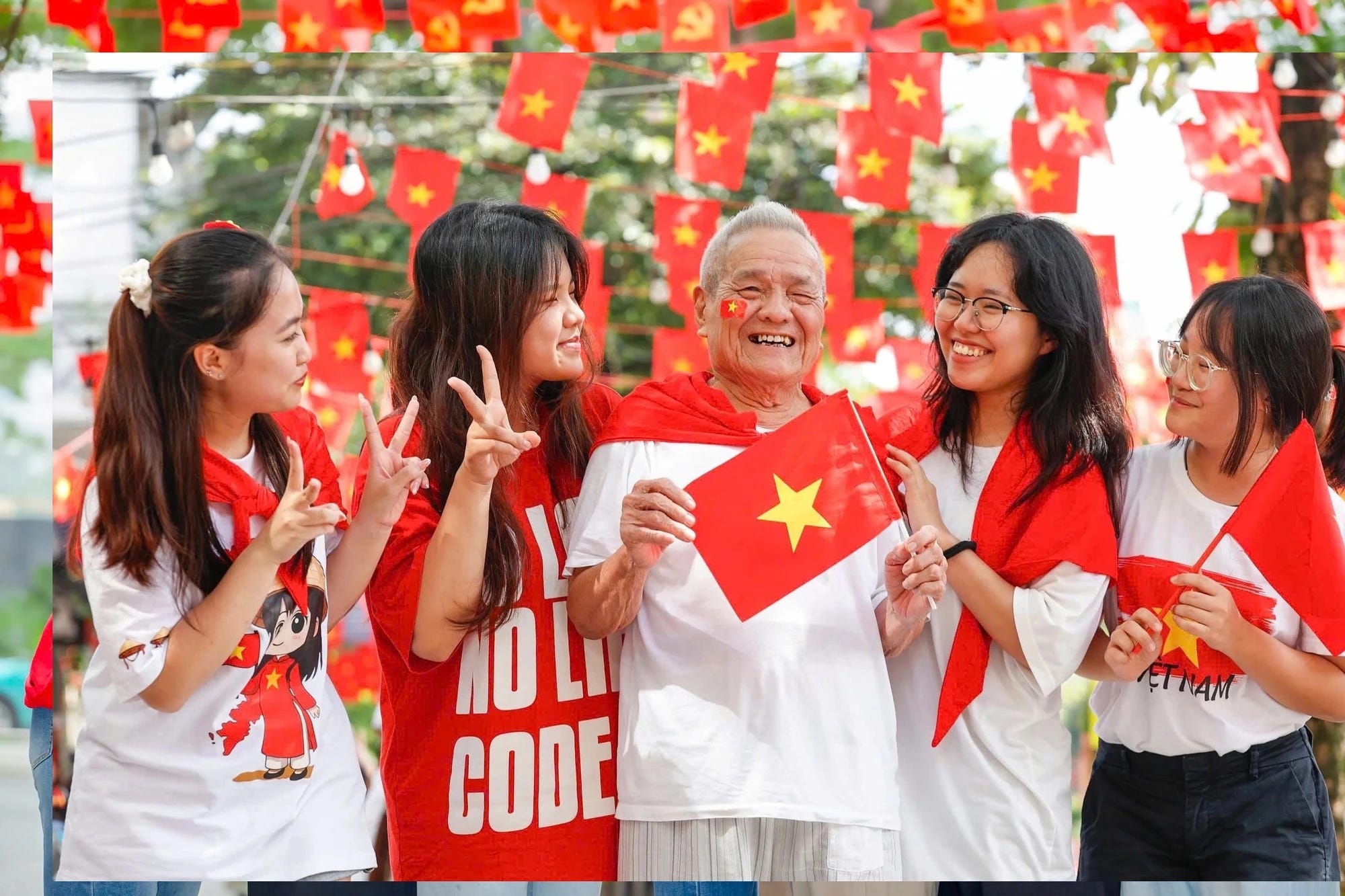
After the September 2 National Day holiday, Vietnam will introduce another notable change to the country’s annual working calendar.
November 24 will officially become Vietnam Cultural Day, with employees entitled to a day off with full pay. This is a new policy introduced in 2026 and took effect on July 1, 2026.
But for businesses, the most important issue is not simply the addition of another public holiday.
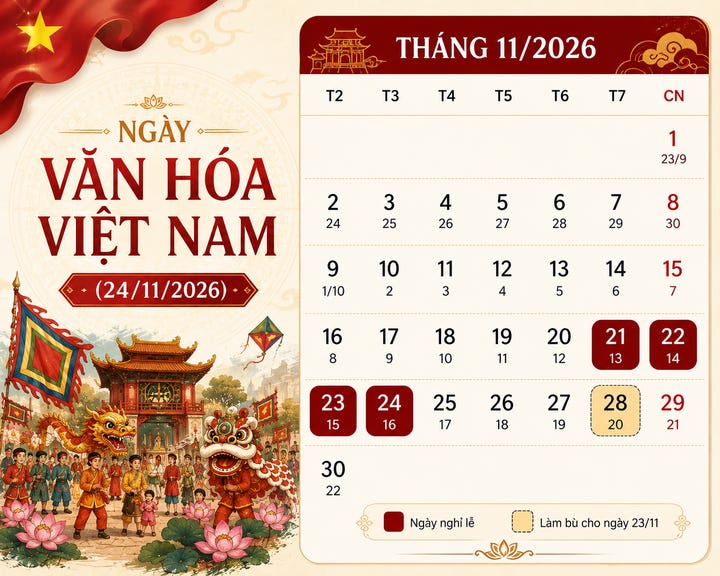
In 2026, November 24 falls on a Tuesday. The Ministry of Home Affairs has proposed swapping a working day to create a four-day consecutive break from Saturday, November 21 through Tuesday, November 24, with Monday, November 23 moved to Saturday, November 28.
For employees, this could mean a longer break.
For businesses particularly manufacturers, logistics companies, and companies serving international customers it is a question of planning.
What Is New About November 24?
Vietnam Cultural Day is more than a new commemorative date.
Under Resolution 28/2026/QH16 on Vietnam’s cultural development, November 24 every year is designated as Vietnam Cultural Day, and employees are entitled to a paid day off. The resolution took effect on July 1, 2026.
This matters for businesses because November 24 is no longer simply a day off that an employer may choose to provide.
It has become a statutory paid holiday.
In practical terms, companies need to include November 24 in their HR, payroll and operational planning, just as they do with other statutory holidays.
Why Could 2026 Bring a Four-Day Break?
The issue comes down to how November 24 falls on this year’s calendar.
November 24, 2026 is a Tuesday.
If employees simply take the statutory holiday, they would have Tuesday off while Monday, November 23 would remain a normal working day.
The Ministry of Home Affairs therefore proposed two possible approaches.
Option 1: Swap Working Days to Create a Four-Day Break
Under the proposed arrangement:
Saturday, November 21: Weekly day off
Sunday, November 22: Weekly day off
Monday, November 23: Day off through workday substitution
Tuesday, November 24: Vietnam Cultural Day
Saturday, November 28: Make-up working day
This would create four consecutive days off.
The Ministry said the arrangement would give people more time to participate in cultural activities while also supporting tourism, services and consumer spending.
Several government bodies, including the Vietnam General Confederation of Labour, the Ministry of Construction, the Ministry of Health, and the Ministry of Culture, Sports and Tourism, have agreed with the proposed arrangement.
Option 2: Take Only November 24 Off
The second approach is for employees to take Tuesday, November 24 off without swapping the Monday working day.
This distinction matters for businesses.
“November 24 is a statutory holiday” and “every company must close for four days” are not the same thing.
The November 24 paid holiday is established under the new resolution.
The workday swap to create a four-day break is an arrangement for organizing the working calendar.
Are Companies Required to Give Employees Four Days Off?
This is probably the most important question for HR and management teams.
The answer is: businesses should not assume that the four-day break automatically applies to every private-sector employer in exactly the same way as it does to government agencies.
Under the Ministry of Home Affairs’ guidance, employees at businesses are entitled to a paid day off on Tuesday, November 24, 2026.
At the same time, the Ministry encourages employers to apply the four-day arrangement where appropriate, provided employee entitlements are fully protected and the arrangement is consistent with the company’s production and business plans.
This distinction is critical.
A professional services company may find it relatively easy to close from November 21- 24.
But a factory operating three shifts, a logistics company with fixed delivery schedules, or a manufacturer supplying components to overseas customers may need a different operating arrangement.
The right question is therefore not simply whether the business will close.
It is whether the business can maintain business continuity.
What Does This Mean for Foreign-Invested Companies?
For foreign companies operating in Vietnam, public holidays can create a much larger issue than simply closing the office.
The underlying challenge is the difference between the Vietnam operating calendar and the global operating calendar.
A company may have:
A factory in Vietnam
Customers in the United States
A headquarters in China, Japan or South Korea
Suppliers across multiple countries
Warehouses and logistics operations running continuously
Employees working across multiple shifts
In that situation, one additional holiday can create a chain reaction.
For example, a factory may be scheduled to deliver a shipment on November 24.
If production planning does not account for the holiday, the company could face:
Holiday → staffing shortage → production delay → delayed QC → delayed packing → delayed logistics → delivery commitment risk.
This is why foreign-invested companies should not wait until November to address the issue.
A New Public Holiday Can Create New Costs
From an HR perspective, November 24 creates a paid non-working day.
But the financial impact is not limited to one payroll entry.
Businesses may need to consider:
1. Payroll
HR and payroll teams should update the new holiday in attendance, payroll and HR management systems.
This is particularly important for companies using automated payroll systems or ERP integrations.
2. Overtime
If production cannot stop on November 24, the company needs to assess the applicable overtime pay and working conditions for work performed on a statutory holiday.
November 24 should not simply be treated as an ordinary working day.
3. Shift Planning
Factories operating multiple shifts need to determine:
Which shifts will continue operating?
Who will take the holiday?
Who will work?
Will additional overtime be required before or after the holiday?
Is backup staffing necessary?
4. Logistics
If the factory closes but logistics operations continue, companies should review:
Trucking schedules
Warehouses
Ports
Customs clearance
Transportation capacity
Delivery appointments
One closed link in the chain can delay the entire operation.
The Four-Day Break Is Also a Year-End Planning Variable
November is not necessarily a low-activity period.
For some industries, it can be a critical period for completing annual targets.
For example:
Manufacturing
Factories may need to complete production orders before the holiday.
Retail & Consumer
Companies may be preparing for the year-end shopping season.
Logistics
Order volumes and inventory planning may begin to increase.
Professional Services
Companies may be working toward project deadlines before December.
Foreign-invested companies
The parent company may continue operating normally while the Vietnam team is on holiday.
The issue is therefore not simply:
“Are we taking the holiday?”
The better question is:
Does the business know how its operations will change when Vietnam’s working calendar changes?
A Simple Example: A China+1 Manufacturer
Consider a Chinese manufacturer that has recently established a factory in Vietnam.
Its China headquarters continues operating normally on November 24.
Its US customers are also working.
But its Vietnam production team is on holiday.
If the company has not incorporated November 24 into its production calendar, it may discover a capacity problem only a few weeks before a delivery deadline.
A simple planning process earlier in Q4 could solve much of the risk:
October
→ Confirm holiday calendar
→ Assess production capacity
Early November
→ Adjust production schedule
→ Confirm inventory buffer
Mid-November
→ Complete orders with deadlines around the holiday
→ Confirm logistics arrangements
November 21- 24
→ Execute holiday and shift plan
This is a good example of the difference between setting up a business in Vietnam and actually operating one.
Vietnam Incorporation Guide
EXPAND YOUR BUSINESS IN VIETNAM
Navigate Vietnam’s market with practical insights and access to Vietnam Operations’ network of experienced professionals across market entry, legal, tax, accounting, HR, recruitment, and business operations.
Connect with Our Expert Network now.
What Should Businesses Do Now?
There is no reason to wait until November.
A relatively simple checklist can help HR and operations teams avoid most problems.
1. Update the 2026 Holiday Calendar
Add November 24 to HR, payroll, ERP and production calendars.
2. Monitor the Final Workday-Swap Arrangement
Do not automatically assume that November 21- 24 will be a mandatory four-day closure for every business.
Companies should monitor the final official guidance and determine which arrangement applies to their operations.
The Ministry of Home Affairs has proposed the four-day arrangement, and multiple ministries and the Vietnam General Confederation of Labour have supported it, but the formal arrangement should be followed according to the final government decision.
3. Review Employment Policies
HR teams should review:
Internal labour regulations
Employee handbooks
Working schedules
Shift policies
Overtime policies
Payroll configuration
Vietnam Incorporation Guide
EXPAND YOUR BUSINESS IN VIETNAM
Navigate Vietnam’s market with practical insights and access to Vietnam Operations’ network of experienced professionals across market entry, legal, tax, accounting, HR, recruitment, and business operations.
Connect with Our Expert Network now.
4. Check Production Capacity
For manufacturing companies, review:
Production orders
Inventory levels
Raw material availability
Delivery deadlines
Machine maintenance
Staffing requirements
5. Notify International Customers Early
If overseas customers do not observe the same holiday, companies should communicate Vietnam’s operating schedule in advance.
This is especially important for businesses working under SLAs or contractual delivery commitments.
This Is Not Just an HR Issue
A common mistake is to treat holiday planning as an HR-only matter.
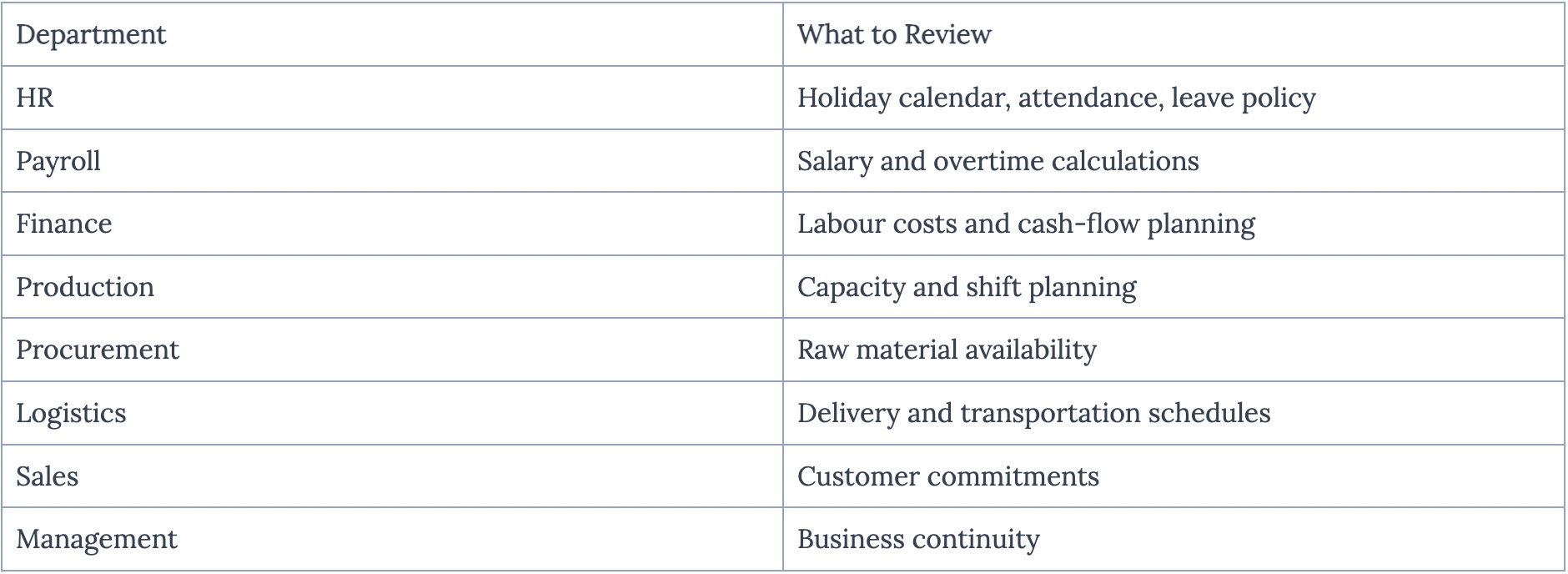
In reality, one additional statutory holiday can affect multiple departments.
This is why companies with complex operations often build an annual operating calendar, rather than maintaining only an HR holiday calendar.
A Bigger Signal: Vietnam Is Changing How Working Time Is Organized
It would be easy to view November 24 as simply another holiday announcement.
Businesses should look at the broader picture.
Vietnam continues to adjust policies related to labour, culture, social welfare and quality of life.
The designation of November 24 as Vietnam Cultural Day, together with the paid day off for employees, is one example.
It also demonstrates why companies operating in Vietnam need to monitor more than tax and investment regulations.
Labour policy is also business policy.
A seemingly small change to the working calendar can affect production capacity, payroll, logistics and customer delivery.
For foreign investors entering Vietnam, this is one of the important differences between simply reading the law and actually operating a business in the country.
So How Should Businesses Prepare for November 24, 2026?
The most practical approach is to think about the issue in two layers.
Layer 1: Legal Compliance
Businesses must ensure employees receive the statutory holiday entitlement and pay applicable to November 24.
This is the must-do.
Layer 2: Operational Planning
The company then determines how to organize operations around its business model:
Close for four days
Close only on November 24
Maintain selected production shifts
Adjust production schedules
Arrange backup staffing
Increase inventory buffers
Adjust delivery timelines
This is the business-planning layer.
The two should not be confused.
A Four-Day Holiday Is Not the Problem. Being Unprepared Is.
Vietnam Cultural Day is an important policy change in 2026.
Employees are entitled to a paid day off on November 24 under Resolution 28/2026/QH16.
For 2026, the proposed arrangement would create a four-day break from November 21 through November 24, with the November 23 working day swapped to November 28. Multiple ministries and the Vietnam General Confederation of Labour have supported this approach.
But businesses need to distinguish between the statutory holiday entitlement and the workday-swap arrangement that creates the four-day break.
For an office-based company, this may simply mean updating the calendar.
For a factory, logistics company or foreign-invested business, it can affect an entire operating chain.
And that is precisely why businesses should start treating holiday calendars as part of operational planning, not simply an HR issue.
Conclusion: Foreign Investors Need to Look Beyond the Holiday
Vietnam is becoming a market where foreign investors need to understand not only where to invest, but also how to operate.
From holiday schedules and labour regulations to payroll, production, logistics and tax, seemingly small local details can create significant operational consequences.
If your company is:
Establishing a company in Vietnam;
Setting up or expanding a manufacturing operation;
Moving part of its supply chain to Vietnam;
Building a local workforce;
Or already operating in Vietnam but is unsure whether its local operations are fully compliant,
Vietnam Operations can help you understand the operational layer behind Vietnam’s regulations and turn those requirements into practical plans for your business.
Talk to Vietnam Operations about your Vietnam investment, setup and operational planning needs.