


Vietnam remains one of Southeast Asia’s most attractive destinations for foreign investors, particularly in manufacturing, trading, technology, and professional services. Supported by a strategic location, competitive labor costs, and an expanding network of free trade agreements (FTAs), Vietnam continues to attract significant foreign direct investment (FDI) from around the world.
However, establishing a company in Vietnam is not simply a straightforward administrative process. In 2026, increasing regulatory oversight and more digital government procedures mean that foreign investors must carefully prepare before entering the market. Many businesses experience unexpected delays because they choose the wrong company structure, overlook licensing requirements, or fail to prepare for post-incorporation obligations such as capital contribution deadlines and tax registration procedures.
Successfully incorporating a company in Vietnam involves more than obtaining the required certificates. Investors should establish a business structure that protects their investment, supports compliance, and enables future growth.
This guide provides a practical overview of the Vietnam incorporation process, including business structures, registration procedures, timelines, costs, and compliance requirements for foreign investors.
Common Business Structures for Foreign Investors
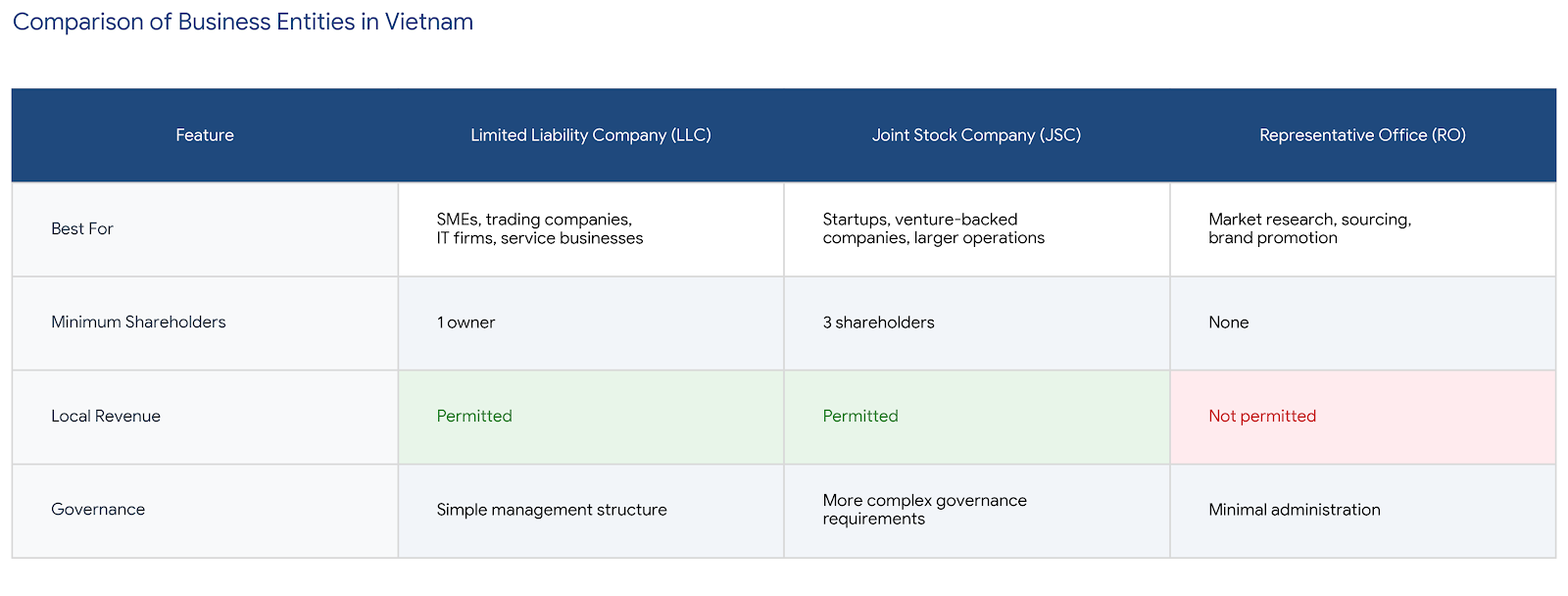
Structure Comparison at a Glance
For most foreign investors entering Vietnam, the Limited Liability Company (LLC) remains the most popular option because it offers flexibility, relatively simple management, and full commercial operating rights.
Vietnam Incorporation Guide: The Company Incorporation Process in 2026
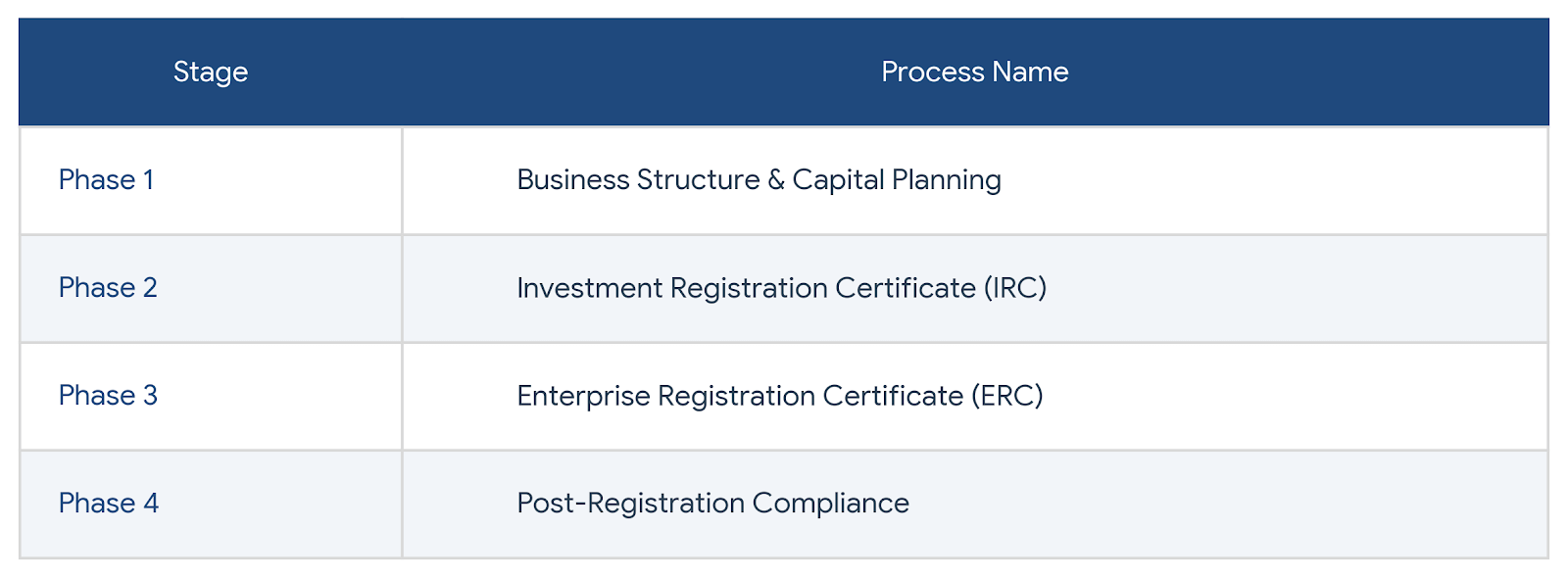
Incorporating a foreign-invested company in Vietnam typically involves several stages. Although applications are now submitted electronically through the National Business Registration Portal, authorities continue to carefully review supporting documents and investment information.
Step 1: Business Structure and Capital Planning
Before preparing incorporation documents, investors should determine:
Business activities and applicable VSIC industry codes
Ownership structure
Registered office address
Charter capital amount
Charter capital is one of the most important considerations during the incorporation process.
Although most service, consulting, and technology businesses do not have a legal minimum capital requirement, authorities carefully assess whether the proposed capital is sufficient for the planned business activities.
Practical Consideration
In practice, an unrealistically low charter capital amount may result in additional clarification requests and longer processing times during the investment review process.
For many service-based businesses, foreign investors commonly register charter capital between USD 10,000 and USD 20,000 to demonstrate their ability to cover initial operating expenses. Trading, logistics, and manufacturing companies generally require higher capital levels due to inventory, facilities, equipment, and operational expenses.
Step 2: Obtain the Investment Registration Certificate (IRC)
If foreign investors own shares in the company from the beginning, obtaining an Investment Registration Certificate (IRC) is generally required.
The IRC records key details of the investment project, including:
Investment objectives
Business activities
Ownership structure
Charter capital
Capital contribution schedule
The application is reviewed by the relevant investment authority before approval.
Typical Processing Time:
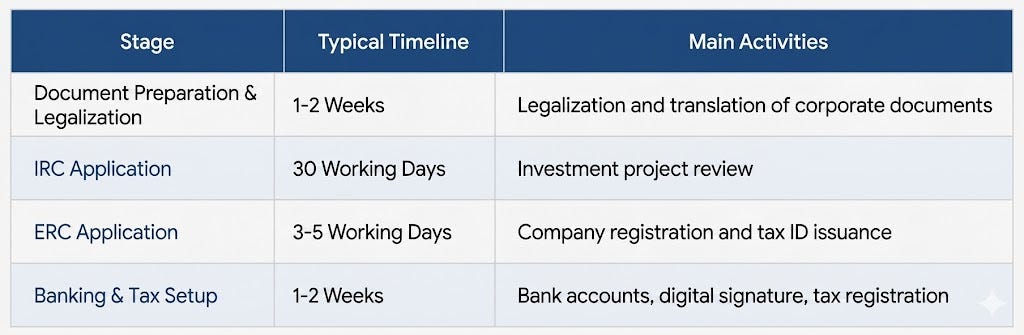
30 working days after submission of a complete and properly legalized application dossier.
Step 3: Obtain the Enterprise Registration Certificate (ERC)
Once the IRC has been approved, investors can apply for the Enterprise Registration Certificate (ERC).
The ERC officially establishes the company as a legal entity in Vietnam and includes:
Company registration number
Tax identification number
Legal company information
Typical Processing Time:
3-5 working days.
After the ERC is issued, the company legally exists but must still complete several important compliance steps before commencing normal operations.
Critical Post-Registration Compliance (Where Most Investors Fail)
Many foreign investors focus heavily on obtaining the IRC and ERC but underestimate the importance of post-registration compliance requirements.
The first 90 days following incorporation are particularly important.
1. The Strict 90-Day Capital Injection Deadline
Vietnamese regulations require investors to fully contribute the registered charter capital within 90 days from the date the ERC is issued.
Failure to meet this deadline may result in:
Administrative penalties
Mandatory adjustment of registered capital
Additional reporting and compliance procedures
Foreign investors should therefore plan capital transfers carefully before completing incorporation.
2. Dual-Account Banking Requirement for FDI Companies
Foreign-invested enterprises must establish a banking structure that complies with Vietnam’s foreign exchange regulations.
Direct Investment Capital Account (DICA)
The DICA is used for:
Capital contributions from foreign investors
Profit remittance overseas
Capital transfers and repatriation transactions
Current Account
The Current Account is used for daily business activities such as:
Supplier payments
Employee salaries
Tax payments
Operating expenses
Important Note
Charter capital should be transferred through the Direct Investment Capital Account (DICA) in accordance with foreign exchange regulations.
Transferring investment capital incorrectly may create significant compliance and foreign exchange complications and make future profit repatriation more difficult.
3. Tax Registration and Digital Setup Requirements
Within the initial period after incorporation, companies should complete several tax and compliance registrations, including:
Obtaining a Digital Signature (Chữ ký số)
Activating the corporate tax account
Registering electronic invoices
Declaring and paying Business License Tax
These registrations are essential for maintaining tax compliance and conducting normal business operations.
4. Industry-Specific Licenses
For businesses operating in conditional sectors, obtaining the ERC alone is not sufficient.
Additional licenses may be required before commercial operations can begin.
Common examples include:
Retail distribution licenses
Education licenses
Logistics permits
Recruitment licenses
Tourism licenses
The specific requirements depend on the company’s business activities and investment structure.
Common Mistakes Foreign Investors Make During Incorporation
Although the legal framework is relatively straightforward, foreign investors frequently encounter delays because of avoidable mistakes.
Common issues include:
Registering insufficient charter capital for the proposed business activities
Selecting incorrect VSIC business codes
Missing the 90-day capital contribution deadline
Delaying tax registration and electronic invoice setup
Assuming that the ERC alone is sufficient for regulated industries
Overlooking work permit and visa requirements for foreign managers
Addressing these issues early can significantly reduce approval delays and compliance risks.
Cost and Timeline Summary (Realistic 2026 Benchmarks)
For a standard foreign-invested company operating in a non-restricted sector, the incorporation process typically takes between four and eight weeks.
The total cost of incorporation generally includes:
Government registration fees
Document legalization and translation costs
Office lease expenses
Banking setup costs
Professional advisory and incorporation service fees
Actual costs vary depending on the business sector, investment structure, and licensing requirements.
Why Many Foreign Investors Use Professional Incorporation Services
Although the incorporation process is clearly regulated, practical implementation often involves additional requirements, document revisions, and communication with multiple authorities.
Small errors in document preparation, business activity selection, or licensing strategy can result in additional information requests and longer processing times.
Professional incorporation support helps businesses avoid unnecessary delays and compliance issues while allowing management teams to focus on their expansion plans and operational priorities.
Vietnam Corporate Services Support
Vietnam Operations connects businesses with trusted corporate service providers in Vietnam, supporting investors, startups, and foreign companies throughout their market entry and operations.
Our network provides support across key areas including company incorporation, corporate secretarial services, accounting & finance, taxation, HR & payroll, immigration, compliance, and business advisory.
Whether you need assistance with company setup, tax compliance, accounting, work permits, or ongoing business operations, we can connect you with the right experts to support your Vietnam journey.
Contact us to explore suitable solutions for your business needs.