

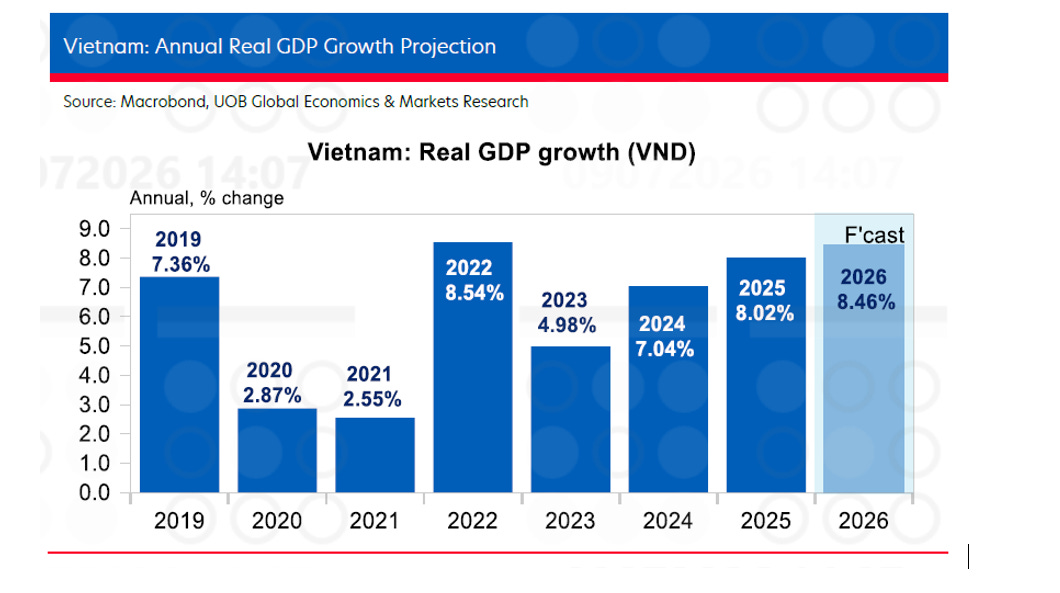
Just a few months ago, Singapore-based UOB projected Vietnam’s economy would grow 7.0% in 2026. Today, the bank has raised that forecast significantly to 8.5%, following a stronger-than-expected first half of the year.
A 1.5 percentage-point upgrade from one of Southeast Asia’s largest banks is notable. But the headline itself isn’t the most important takeaway.
The real question is: what changed, and what does it tell us about Vietnam’s economy going forward?
Vietnam’s Growth Is Exceeding Expectations
According to Vietnam’s General Statistics Office (GSO), GDP expanded 8.18% in the first six months of 2026, while second-quarter growth accelerated to 8.39%, up from 7.94% in Q1. Those figures exceeded market expectations and prompted UOB to revise its full year GDP forecast upward from 7.0% to 8.5%.
For international investors, this matters because Vietnam is no longer simply recovering from a difficult period it is outperforming expectations while many export-driven economies across Asia continue facing weaker global demand.
Manufacturing Continues to Drive the Economy
One of the clearest signals behind Vietnam’s stronger outlook is that manufacturing remains the country’s primary growth engine.
Industrial production maintained double-digit growth during the first half of the year, supported by continued expansion in manufacturing and processing industries. UOB also highlighted that Vietnam continues to benefit from ongoing global supply chain diversification, resilient electronics exports, and rising demand for AI related hardware.
Rather than being driven purely by domestic consumption, Vietnam’s current expansion remains closely tied to production, exports and foreign investment.
This reinforces a broader trend Vietnam Operations has covered before: Vietnam is becoming increasingly integrated into higher value manufacturing rather than relying solely on low-cost labor.
Public Investment Is Finally Becoming Visible
Another contributor to stronger growth is infrastructure spending.
According to UOB, fixed asset investment increased by more than 15%, supported by faster disbursement of public investment projects. Large scale investments in expressways, airports and logistics infrastructure are beginning to translate into measurable economic output rather than remaining long-term policy announcements.
For manufacturers and foreign investors, this matters because infrastructure determines how efficiently goods move, how quickly factories can be built and which provinces become viable investment destinations.
Infrastructure may not generate headlines like GDP growth, but it often determines whether that growth can be sustained over the long term.
A Trade Deficit Isn’t Necessarily Bad News
One detail that received less attention is Vietnam’s recent trade balance.
The country has now recorded two consecutive quarters of trade deficits, with imports growing faster than exports. On the surface, that may appear concerning.
However, UOB notes that much of the increase comes from higher imports of machinery, industrial equipment, production inputs and energy products goods that support manufacturing expansion rather than consumer spending.
In other words, Vietnam is importing more because businesses are investing more.
That distinction matters.
A trade deficit driven by capital goods often reflects future production capacity rather than weakening competitiveness.
Why UOB Doesn’t Expect Interest Rates to Rise
Despite stronger growth, UOB expects the State Bank of Vietnam to keep monetary policy broadly unchanged through the remainder of 2026.
The reasoning is straightforward.
Inflation remains relatively contained and is moving close to the government’s target range. Meanwhile, much of the remaining inflationary pressure comes from imported energy prices rather than excessive domestic demand.
Raising interest rates would therefore have only limited impact while potentially slowing investment and business activity.
Instead, policymakers appear focused on maintaining macroeconomic stability while supporting continued growth.
Can Vietnam Reach 10% Growth?
Although UOB upgraded its forecast to 8.5%, it still believes the government’s 10% GDP growth target remains ambitious under current global conditions.
The biggest risks remain external rather than domestic:
Geopolitical uncertainty
Global trade tensions
Higher energy prices
Potential changes to U.S. tariff policies
Slower growth among major export markets
Vietnam has become more resilient over the past decade, but it remains deeply connected to global supply chains. External shocks will continue to influence its growth trajectory.
The Bigger Story Isn’t the Number. It’s the Direction.
Whether Vietnam ultimately grows by 8.5% or slightly above or below that figure matters less than what is driving the expansion.
The country’s economy is becoming increasingly supported by:
Advanced manufacturing
Continued foreign direct investment
Infrastructure development
Stronger policy execution
Integration into technology and AI-related supply chains
These are structural shifts rather than short-term cyclical rebounds.
For businesses evaluating Vietnam, the conversation is gradually changing.
The question is no longer “Is Vietnam growing?”
Instead, it is “Can our business keep pace with how quickly Vietnam is evolving?”
That may prove to be the more important story over the coming decade.