


Vietnam’s population is still growing. But the country’s greatest demographic advantage is quietly disappearing much faster than many businesses realize.
For decades, Vietnam has been one of Asia’s most attractive investment destinations for one simple reason: people.
A young workforce.
Abundant labor.
A growing consumer market.
That demographic engine helped power Vietnam’s rise from a low-income country into one of the world’s fastest-growing manufacturing and consumption markets.
But that engine is beginning to slow.
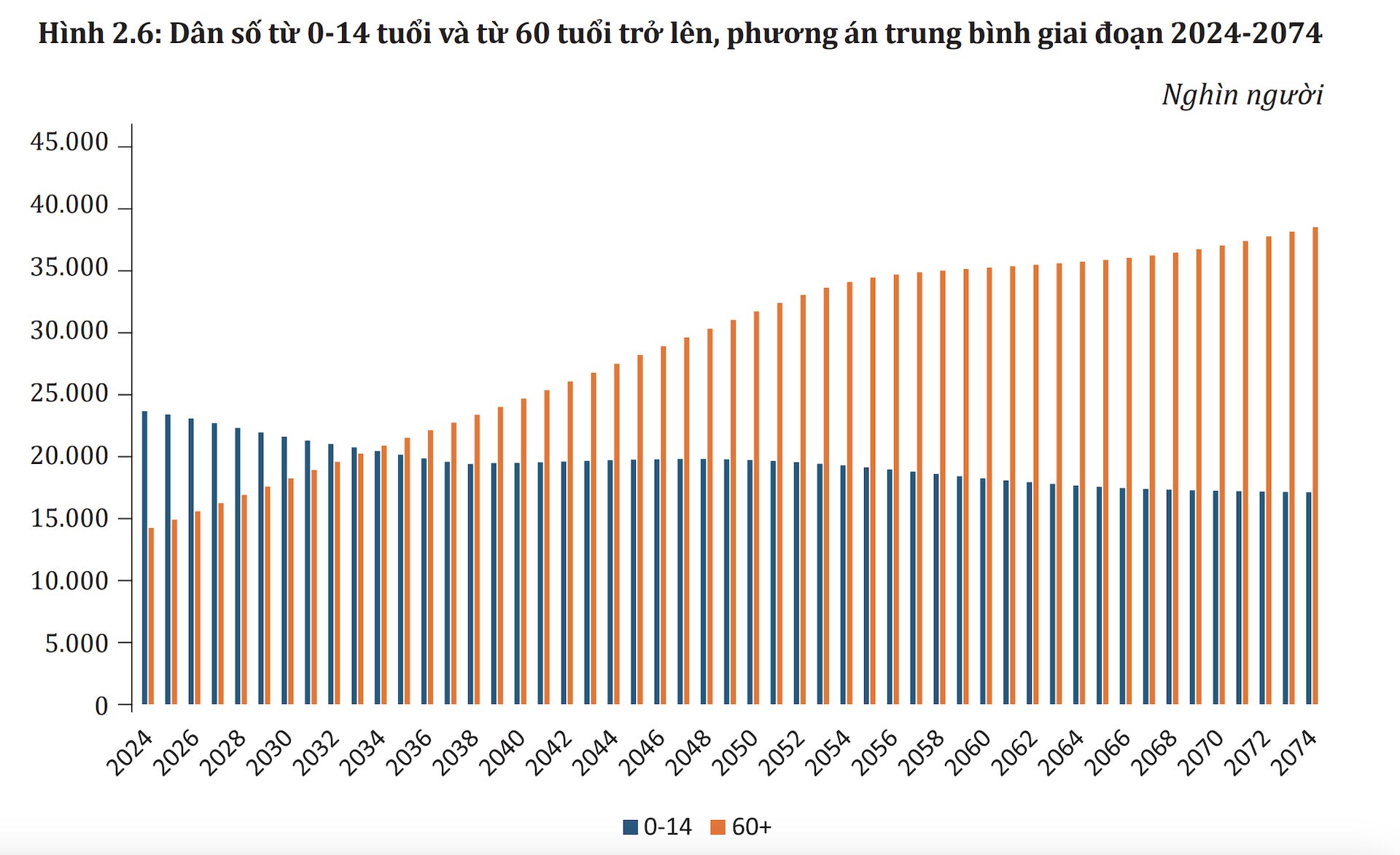
According to Vietnam’s latest population projections, the country’s population is expected to stop growing around 2060, before entering a period of decline. More importantly, Vietnam’s golden population period may end as early as 2036, while the country transitions into an aging society much faster than previously expected.
Vietnam’s Competitive Advantage Is Changing
Many foreign investors still think of Vietnam as a country with an endless supply of young workers.
That assumption is becoming outdated.
Vietnam currently has more than 100 million people, making it one of the world’s largest consumer markets. However, fertility rates have fallen below replacement level in many provinces, especially major economic centers like Ho Chi Minh City and the Mekong Delta.
Population projections from the General Statistics Office now suggest:
Population growth could reach zero around 2060
Under a lower-fertility scenario, population decline could begin as early as 2051
From 2061 onward, Vietnam is expected to enter negative population growth under the medium scenario.
For companies planning decades-long investments, these timelines matter.
Factories built today will still be operating when labor becomes significantly scarcer.
The Real Deadline Isn’t 2060
Ironically, businesses shouldn’t focus on 2060.
They should focus on 2034-2036.
According to demographic forecasts:
Older adults are expected to outnumber children around 2034
Vietnam’s demographic dividend is projected to end around 2036
By 2050, Vietnam could become a super-aged society, with people aged 65 and above accounting for more than one-fifth of the population.
That leaves barely a decade before one of Vietnam’s greatest structural advantages begins fading.
Labor Will Become More Expensive
For years, Vietnam competed primarily on labor costs.
In the future, it will compete on labor productivity.
A shrinking working-age population typically means:
Higher wage pressure
Greater competition for skilled employees
More automation
Faster adoption of AI
Increased investment in worker productivity
This transition is already happening across developed Asian economies.
Vietnam is unlikely to be an exception.
Companies that continue relying solely on inexpensive labor may find themselves under increasing pressure over the next decade.
Consumption Will Also Change
An aging society doesn’t necessarily mean weaker consumption.
It means different consumption.
Healthcare.
Financial planning.
Insurance.
Retirement services.
Home care.
Wellness.
Medical technology.
Senior housing.
These industries could experience structural demand growth over the coming decades.
Meanwhile, sectors heavily dependent on young consumers may need to rethink long-term strategies.
Demographics don’t eliminate demand.
They reshape it.
Manufacturing Needs a New Playbook
Vietnam has become a global manufacturing hub largely because of its workforce.
As labor tightens, manufacturers will increasingly need to focus on:
Automation
Digital transformation
Smart factories
Workforce retention
Upskilling instead of constant hiring
The conversation shifts from finding more workers to getting more productivity from each worker.
Countries like Japan and South Korea have already experienced this transition.
Vietnam may simply be reaching that stage earlier than expected.
Investors Should Think Beyond Population Size
A population of over 100 million still represents a major market.
The issue isn’t today’s population.
It’s tomorrow’s population structure.
Many investment decisions from industrial parks and logistics to retail, healthcare, education and housing are built around long-term demographic assumptions.
If those assumptions change, investment strategies may need to change as well.
The winners won’t necessarily be those betting on population growth.
They’ll be those adapting early to population aging.
Final Thoughts
Vietnam’s demographic story isn’t ending.
It’s evolving.
The country still offers enormous opportunities:
A large domestic market
Strong manufacturing ecosystem
Strategic geographic location
Deep global trade integration
But the source of competitive advantage is gradually shifting.
The next chapter of Vietnam’s economy will depend less on how many workers the country has and more on how productive each worker becomes.
Businesses that recognize this shift early may be better positioned for the decades ahead.